Unison Said to Select Banks for US IPO
Bloomberg reported that Unison, the San Francisco home equity-sharing firm, has picked banks for a planned US initial public offering. Unison's core deal is simple on its face: a homeowner gets cash now, and in exchange Unison takes a share of the home's future appreciation. There is no monthly payment and no interest, and the homeowner keeps full ownership. Naming underwriters is an early and reversible step, more a declaration of intent than a dated calendar, but a listing of this company would still be unusual. It would put a public price on home equity investing, a fast-growing slice of American housing finance that until now has traded almost entirely among private funds and institutional investors.
The question worth asking is not whether Unison lists, but what its model actually earns and what could break it. The answer runs through a single contested word: whether Unison's product is a bold new financing tool or a mortgage loan wearing a disguise. That classification decides the economics of the entire business.
The trade underneath the product
Unison started in 2004, and its arrangements come in two flavors. The original home equity agreement pays homeowners an upfront sum for a slice of future appreciation; the more recent equity-sharing home loan adds an interest component on top of a deferred share. Either way, Unison's return depends on home prices rising. In a flat or falling market, the money it advances earns little or nothing for years, because the payoff is only realized when the home is sold or the term ends.
That makes Unison an asset-heavy, capital-demanding business rather than a fee-light software shop. It must fund each advance with money it has gathered elsewhere. Its June 2021 equity round raised $210 million; a February 2022 round added $443 million in debt financing; and in 2024 Carlyle agreed to buy as much as $300 million of Unison's equity-sharing loans. Homeowners are one side of the trade, but institutional buyers of its loans - and ultimately public shareholders - sit on the other.
The legal fog an IPO must price
The product's appeal, the absence of monthly payments and interest, depends on courts and regulators treating it as something other than a loan. That status is under active attack. A federal lawsuit filed in North Carolina in September, reported by HousingWire, accuses Unison of operating as an unlicensed mortgage lender by disguising its agreements as option contracts, and cites a 2025 Ninth Circuit ruling in Olson v. Unison Agreement Corp as precedent that such agreements should be treated as mortgages. The plaintiffs include a couple who received a net advance of about $61,000 but could owe nearly $270,000 to exit their agreement.
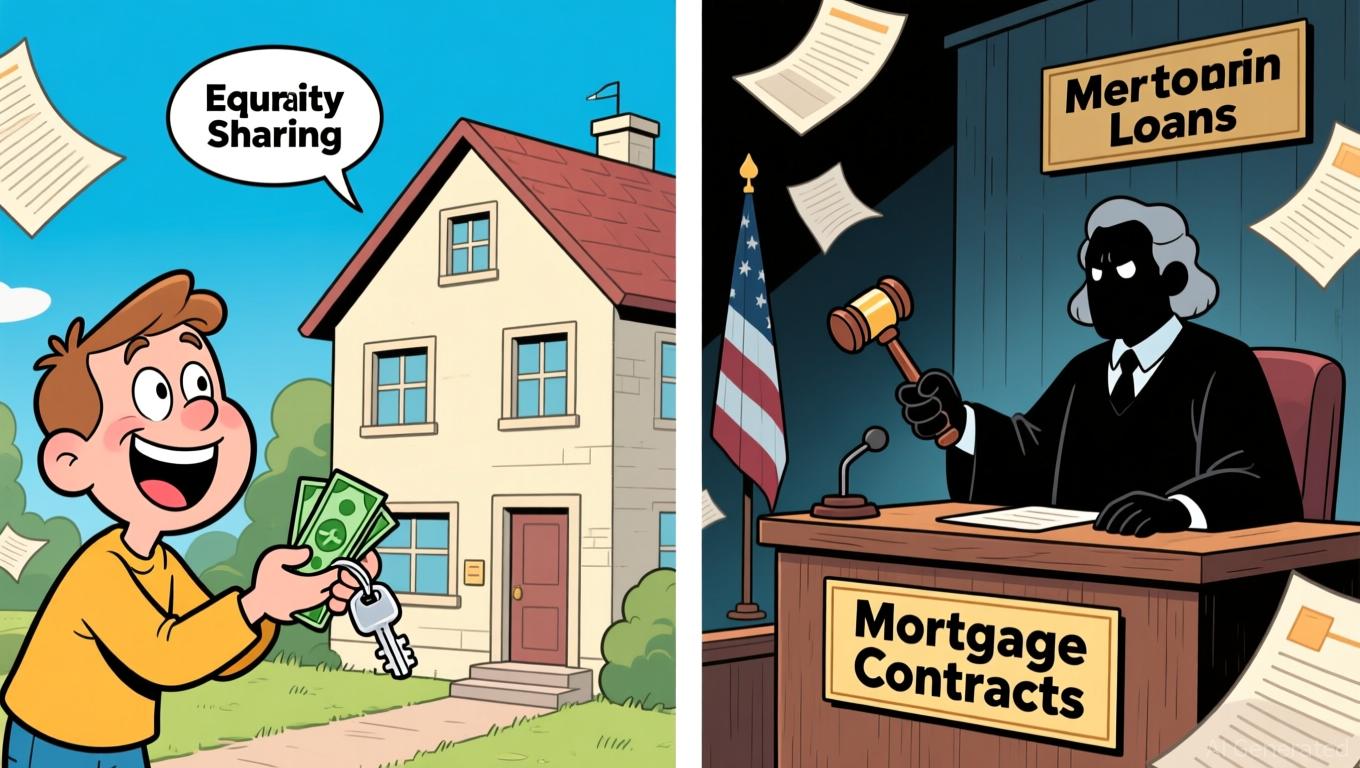
Why this matters financially: if the courts conclude these are loans, the "no monthly payment" pitch dissolves. Unison would face state mortgage licensing, lending disclosures, cost caps, and ability-to-repay requirements - a different compliance burden and a different cost structure, potentially retroactively. Litigation of this kind is a risk that a public filing must quantify, not a footnote it can wave away.
The case on the other side
It would be wrong to assume the courts will side with the plaintiffs. Equity-sharing defenders argue the homeowner gives up an option on future value rather than borrowing, and a listing could settle the question in Unison's favor. Nor is the sector in doubt. The same day the IPO report appeared, rival Point announced it had funded 30,000 homeowners and more than $3 billion in home equity, doubled in under 18 months, and earlier this year closed a $508.6 million securitization. Its chief executive, Eddie Lim, calls home equity investments a "maturing asset class," and the flow of institutional capital behind that description is real.
But industry-wide growth does not resolve Unison's own exposure. Its disputed contracts and the classification question travel into any registration statement, where they become legible to every investor. The sector can be healthy while one company carries an outsized share of the legal cost, and the IPO window itself has been unforgiving - as CNBC reported, biometric-ring maker Oura postponed its own offering in September citing market uncertainty, one of several recent pullbacks.
The evidence to watch
The decisive document will be the registration statement, whenever it arrives. It will have to disclose how Unison treats contested agreements on its books, what reserves it holds for litigation and possible refunds, and whether it has obtained lender licenses where courts have demanded them. Two outcomes would change the assessment: a settlement or licensing step that resolves the classification question ahead of pricing, or a prospectus whose loss reserves and risk language show the disputes are material. Until one appears, the IPO's value rests on a legal question, not a growth story.
Home equity investing has a real and expanding market, and Unison has real backing for it. But the economics that make the pitch attractive - no monthly payments, returns tied to appreciation - are premised on a classification that courts and plaintiffs are actively contesting. The next evidence will come from the filing and from any resolution of that question, and investors should want to see that before they decide what this banker selection is worth.