The 3 a.m. Stock Market Is a Tell, Not an Edge
The International Monetary Fund studied a year of five-minute price prints across tokenized U.S. stocks - blockchain tokens tracking Nvidia, Tesla, Alphabet, the S&P 500 and the Nasdaq - and came back with a number that should stop a retail investor cold: more than half of all trading in those tokens happened while U.S. markets were closed. The instinct is to read that as opportunity - round-the-clock access, never miss a move. The Fund's own data says to read it the other way.
Look at who is doing it and in what size. In the roughly $345 million sample the IMF examined - about 15% of all tokenized equities outstanding, trading across 11 venues - eight out of ten trades were for less than one share. That is not institutions repositioning at midnight; that is small retail buying fractions because a token is the cheapest way to own a sliver of Nvidia. And the whole asset class is a rounding error next to the thing it copies. Tokenized equities came to roughly $2.3 billion as of July 31, 2026; the IMF separately counted about $65 billion in publicly tokenized real-world assets - against some $300 trillion sitting in global capital markets.
The cost of that access is written into price. Tokenized stocks ran about one and a half times the realized volatility of the same shares on a normal exchange, with liquidity thinnest on the decentralized venues, where the order books are the emptiest. Realized volatility just measures how hard a price jerks around; at one and a half times, a fractional Nvidia token wobbles half again as much as the actual stock for no new information. Buy that product at 3 a.m. and you are not capturing a move - you are paying for the privilege of being the only liquidity in the room.
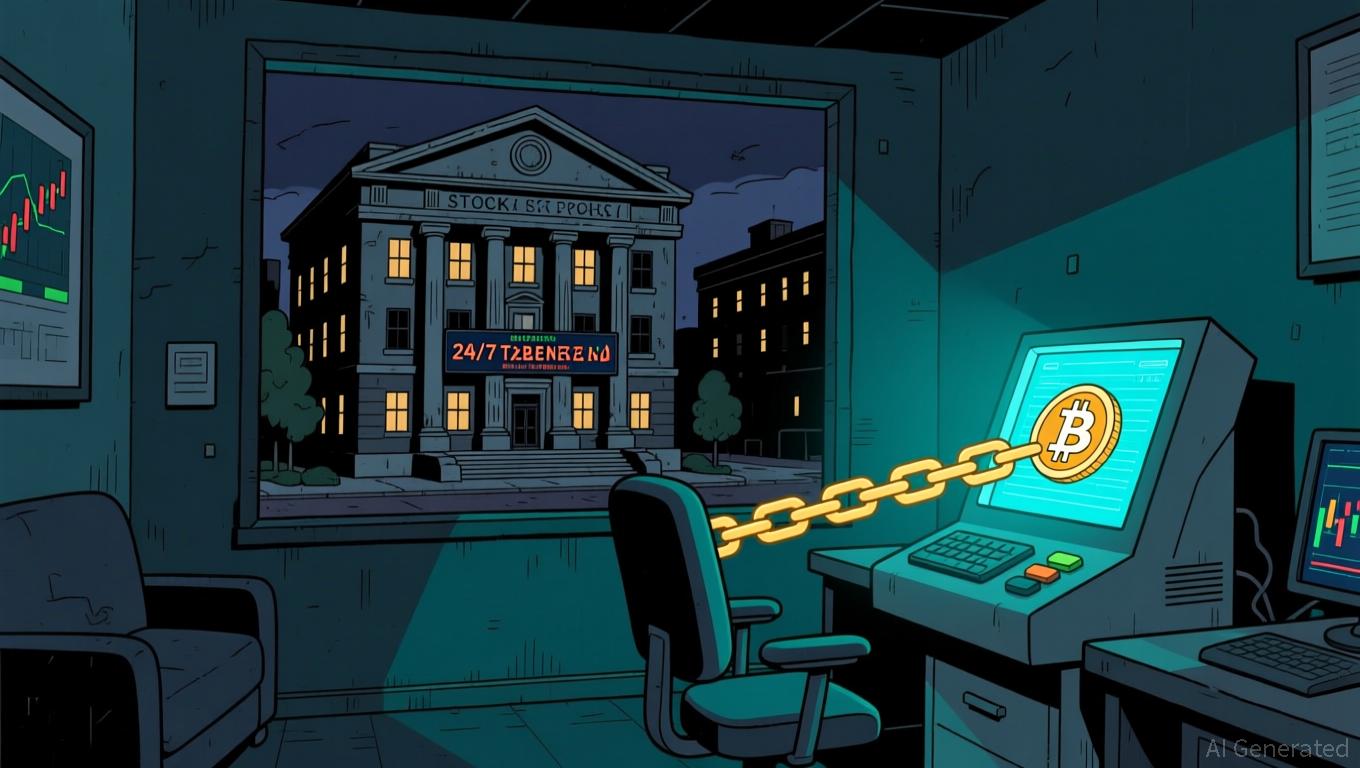
How is a stock even tradeable at three in the morning? Because the cash leg - what you pay with - is a stablecoin, and a stablecoin never closes. The normal market's hours, clearing and settlement are stitched around central settlement windows that shut at 4 p.m. The tokenized market's settlement rail is a dollar-pegged token that settles around the clock. That rail is the entire source of the headline feature - and it is precisely the part the IMF calls the weak link, arguing trades should settle in central-bank money rather than private tokens that carry their issuer's credit and liquidity risk and can face mass withdrawals when confidence slips. The feature that markets the product is the same mechanism that could break it.
None of this makes the off-hours data useless - quite the reverse. Because tokenized stocks keep trading while the U.S. market is shut, they now print an overnight price signal. The IMF found that the ordinary stock price absorbed between 87% and 99% of the overnight price change observed in the tokens - the signal showed up in the stock shortly after the following open. Simplest way to use it: the tiny 3 a.m. market is a leading indicator for tomorrow's opening price, and you can read it without ever trading the thin venue. The information leaks out of the token into the real stock, not the other way around.
The market structure says stay on the information side, not the trading side. Two issuers, Ondo Finance and Backed Finance, account for more than 70% of the tokenized-equity supply, so your token's claim on the actual share runs through one firm's custody and backing - counterparty risk you do not sign up for with a plain ETF. Issuer concentration is one finding, but the IMF's scaling warning runs wider: a market this thin and fragmented, sitting on a settlement rail it distrusts, may amplify runs and fire sales as interconnectedness and leverage build instead of absorbing them.
So the honest edge here is information, not access. Use the overnight tokenized prints as a tell for the open - that part is free. Trade the venue itself at 3 a.m. because twenty-four-seven sounds like an edge, and you are the reason its volatility runs one and a half times the underlying. The product's whole appeal is the hours it trades; its whole risk is that you are the only one there. What might narrow the risks is easy to name and slow to arrive: real liquidity in those empty books, supply spread beyond two issuers, and - for the settlement risk the IMF flags as the weak link - trades moved off stablecoins into central-bank money, the researchers' own prescription. Until then, the midnight stock market is a signal to read, not a casino to visit.