Track the Barrel, Not the Missile
When a missile punches through the departure terminal of Riyadh's King Khalid International Airport on a Saturday evening, most of the world reads it as violence. Markets read it as crude oil. Weekend strikes killed 13 people and forced the airport closed, and by Monday West Texas crude was up more than 2%, near $94 a barrel, while Brent climbed to a two-week high above $105. Airlines scrapped flights and Riyadh authorities said the airport would stay shut until at least October 17.
Nothing about a closed airport moves the oil balance. A plane not taking off from Riyadh does not take a single barrel off the world market. So the market is not pricing the missile. It is pricing what the missile might do next.
Here is the only pipe that carries a war story in the Gulf from a headline to your brokerage account, and it is worth tracing slowly because it is the whole game.
Energy is one of the rare prices a central bank cannot print its way past. Gasoline, jet fuel, freight and electricity all move on crude, and all of it reads straight into the inflation print the Federal Reserve is trying to smash back down. The Fed sets the cost of money. When it cuts rates and pumps liquidity, money is cheap and abundant, and cheap money bids up every asset whose value lives in the future - growth stocks, speculative tech, crypto. When inflation runs hot, the Fed cannot cut, the cheap money stops, and those same assets deflate. Oil is the fastest single lever that makes inflation hot again.
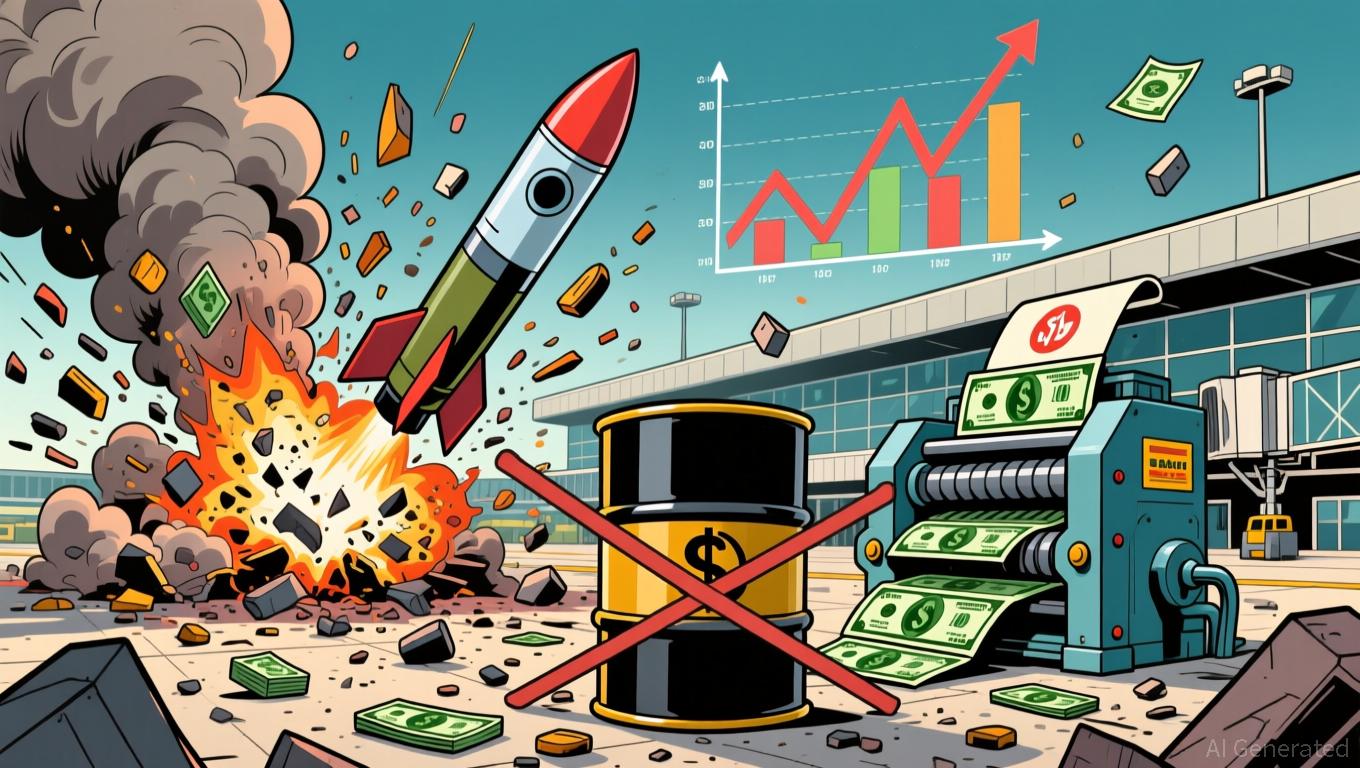
So an oil shock does not behave the way the retail reflex expects. The instinct says crisis, therefore print, therefore risk-on for hard assets. The plumbing says the opposite: an oil shock is one of the few genuine checks on the money-printing engine, the kind of input that pins the Fed's easing path shut precisely when the market is begging for cuts. For the trade that lives on cheap and plentiful liquidity - and bitcoin lives on it more than anything, because a coin is priced in the marginal fiat dollar the credit system creates - this missile is not a tailwind. It is the one event class that can break the machine.
But here is the discipline, and it is the whole point: the barrel has not stopped.
Saudi Arabia's energy minister promised a "serious" response, vowing "our response must be equally serious." Washington floated joining the Saudi campaign against the Houthis. Yet no one has reported a barrel of Saudi crude actually cut from production or exports. The airport is shut. The taps are not.
Now the one number that actually decides whether this stops being a scary headline and becomes your problem: the Strait of Hormuz. Roughly 20 million barrels of crude oil move through that narrow channel daily, about a fifth of everything the world consumes, and a drone had already struck a tanker just outside the strait, off Oman, over the weekend. If that chokepoint closes, or if Saudi exports measurably fall, the risk premium stops being an insurance cost and turns into a real supply gap. That is the difference between oil at $94 because people are nervous and oil at $94 because a fifth of the world's crude cannot get out.
Until the barrel actually stops, the counterweights matter, and they are all working against the geopolitical bid. Trump announced a deal for staged deliveries of Russian diesel to the United States - fresh supply arriving from the opposite direction. A Russian-Ukraine "energy ceasefire" was floated on top of it. And OPEC itself trimmed its forecast for demand growth in 2026. All three push the other way, which is why oil rose a few percent rather than twenty.
So the honest read for your portfolio: right now this is a volatility event priced as risk, not a regime change. Energy producers collect the insurance premium in the near term. But everything that prices itself off cheap, abundant liquidity is genuinely exposed here, and the exposure does not run in its favor. Watch the export data and the strait, not the airport. If Saudi and Iranian barrels keep flowing and the ceasefire and the Hormuz-reopening talks hold, this mean-reverts into a sad regional story your account can ignore. If the barrels stop, the energy complex wins and the cheap-money trade loses the liquidity it was priced for - and that is precisely where a missile in Riyadh finds your bitcoin.