Nurix's $4.73 'Beat' Is One-Time Roche Money, Not a Business
The thesis, in brief
A company that loses money every quarter just printed GAAP EPS of $4.73 and revenue of $673 million, up more than 8,000% year over year. That is a genuinely good event for Nurix Therapeutics, Inc. (NRIX) - but it is not earnings. Almost the entire quarter is a single, one-time $700 million upfront payment from a new global collaboration with Roche on Nurix's lead drug, booked largely as license revenue. Strip out the windfall and the underlying business still loses money every quarter. The muted market reaction - shares down a couple of percent after the print - is the correct read, and I agree with it. The headline 'beat' tells you nothing about whether the stock is cheap; the whole decision rests on bexobrutideg and what you are paying for it.
Past coverage
This is my first article on Nurix, and it sits outside my usual territory - I tend to write on mega-cap tech and energy rather than clinical-stage biotech. But the accounting is the same as anywhere else: a headline number is only as good as the one-time items buried inside it.
What happened, and the tell
Nurix reported its fiscal Q3 results on Monday, October 12. Total revenue came in at $673.1 million - an increase of about 8,420% year over year, versus the $7.9 million it booked in the same quarter last year - and GAAP earnings of $4.73 per share, against a $1.03 per share loss a year earlier. The consensus, which was modeling a loss, was beaten by a wide margin.
The tell is what the stock did with it. This is the kind of print that usually sends a small biotech up double digits. Instead, NRIX traded down a couple of percent at the time of writing, on Ainvest data. That is the 'sell-the-news' response you see when investors recognize that a big number is a lump of one-time money rather than proof that the business suddenly works.
Strip out the windfall
The revenue line breaks down almost entirely into the Roche deal. Of the $673.1 million, $653.2 million was license revenue from the collaboration with Roche, according to the company's release; the balance largely came from the Gilead, Pfizer, and Sanofi collaborations, including a $10 million milestone from Sanofi. Nurix's other licensed programs have been generating single-digit-millions to low-double-digit-millions in revenue per quarter - not hundreds of millions.
To see how real the earnings are, run the quarter without the payment. Operating expenses were roughly $114 million: research and development of $79.3 million (down from $86.1 million, helped by cost-sharing under the Roche deal) and general and administrative costs of $34.4 million (up from $13.2 million, inflated by one-time Roche transaction costs). Against that, the ongoing collaboration revenue is on the order of a few tens of millions a quarter. The $4.73 per share of net income comes from the one-time license revenue, not from a business that has become profitable.
That is why I would not read this quarter's 'beat' as a sign that Nurix's economics have turned. It is a cash injection, and a welcome one - but it is a lump, not a stream.
The deal behind the number, and what you pay for
The transaction is real and meaningful. In June, Roche and Nurix agreed to co-develop and co-commercialize bexobrutideg, an oral BTK degrader that works by destroying the BTK protein rather than inhibiting it, with the goal of overcoming the resistance that plagues existing BTK inhibitors. Roche paid a $700 million upfront, with up to $2.3 billion in total potential consideration. The economics are shared: Nurix and Roche split development costs roughly 40/60, split U.S. profits equally, and Nurix earns tiered royalties on ex-U.S. sales.
Critically, the structure caps what Nurix keeps even in the good case - Roche takes a large share of the money and the milestone upside is bounded - while leaving all the clinical risk in front of it. Bexobrutideg is still in trials. This quarter Nurix dosed the first patient in the registrational Phase 3 DAYBreak study, which pits bexobrutideg against pirtobrutinib in relapsed/refractory chronic lymphocytic leukemia, and it is expanding the drug into autoimmune indications.
The $700 million left Nurix with about $1.1 billion in cash, cash equivalents, and marketable securities as of August 31, up from $592.9 million at the end of last fiscal year, and management says the runway now extends into the second half of 2029. That is the real gift of this quarter: the balance-sheet risk that kills most clinical-stage biotechs is, for now, off the table.
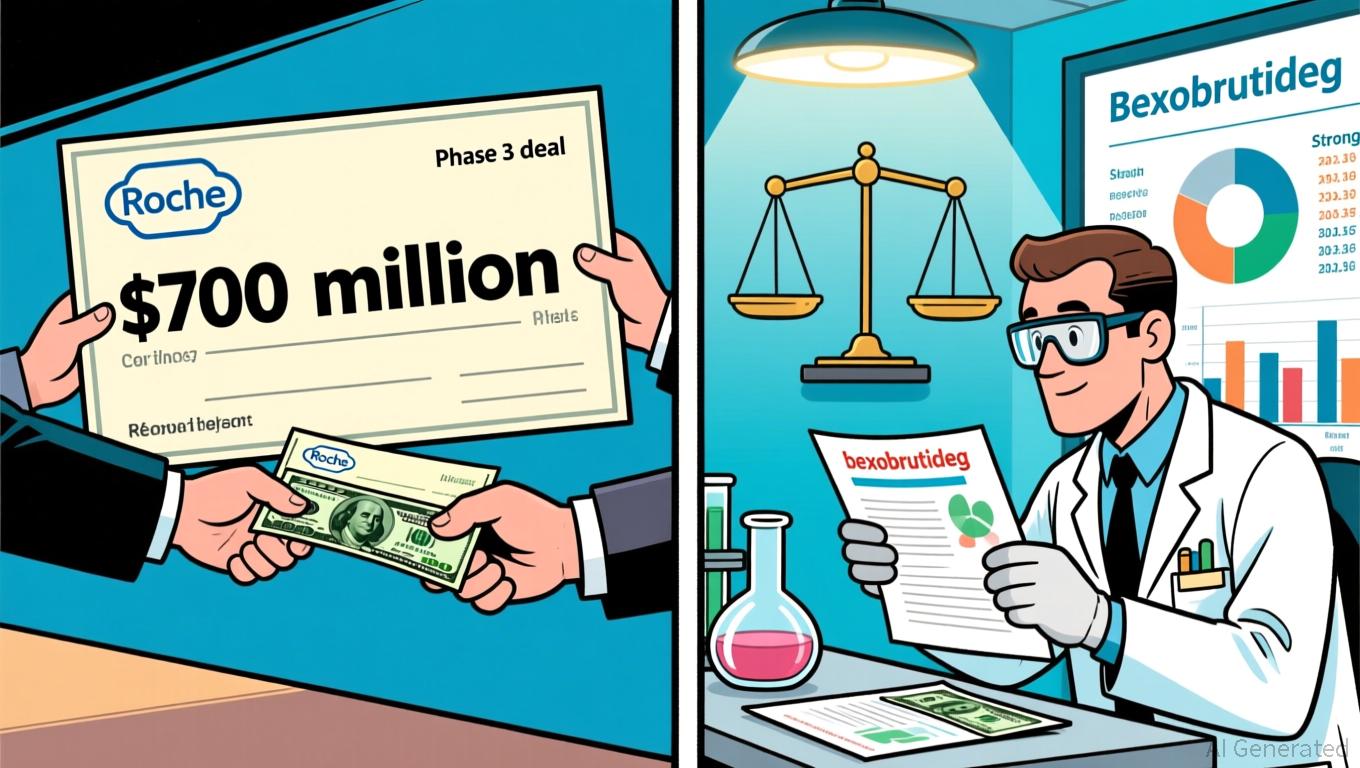
But a strong balance sheet and a de-risked cash position are not the same as a cheap stock. Nurix trades at roughly a $2.3 billion market capitalization, with no positive trailing or forward earnings multiple to anchor it - this quarter's $4.73 per share was non-recurring, so you cannot attach a normal P/E to it. Net of the roughly $1.1 billion of cash, the market is pricing the bexobrutideg bet and the rest of the pipeline at something on the order of $1.2 billion. That is a large price tag for a single clinical-stage drug being co-developed against a partner that takes a big cut, competing with several already-approved BTK inhibitors.
Takeaway
The Roche deal is a genuine milestone, the strongest thing that has happened to Nurix in years. I would grant it fully: it validates bexobrutideg's technology, and it funds the company into the second half of 2029. But a milestone is a green light to review the business, not a green light to buy the stock, and this quarter's $4.73 'beat' is the worst possible frame for that review - it records a check, not a change in the company's ability to generate earnings.
When the one-time money is set aside, the question Nurix's shares ask is narrow and unchanged by this print: will bexobrutideg win its Phase 3 readout and, if it does, will it earn enough to justify roughly $1.2 billion of value beyond the cash pile? That is a bet on unproven clinical and commercial success, at a price I don't find compelling - especially since a failed readout, or a drug that wins approval but sells modestly against entrenched competition, leaves the cash as the floor and the optionality gone. The money Roche wired is real; the earnings story it dressed up for one quarter was not, and it is the underlying story that determines the long-run return here. No investment is risk-free - and in a single-drug clinical-stage company priced off optionality, the risk is not hard to find.